The Hidden Risks of Choosing the Wrong Software for Your Business
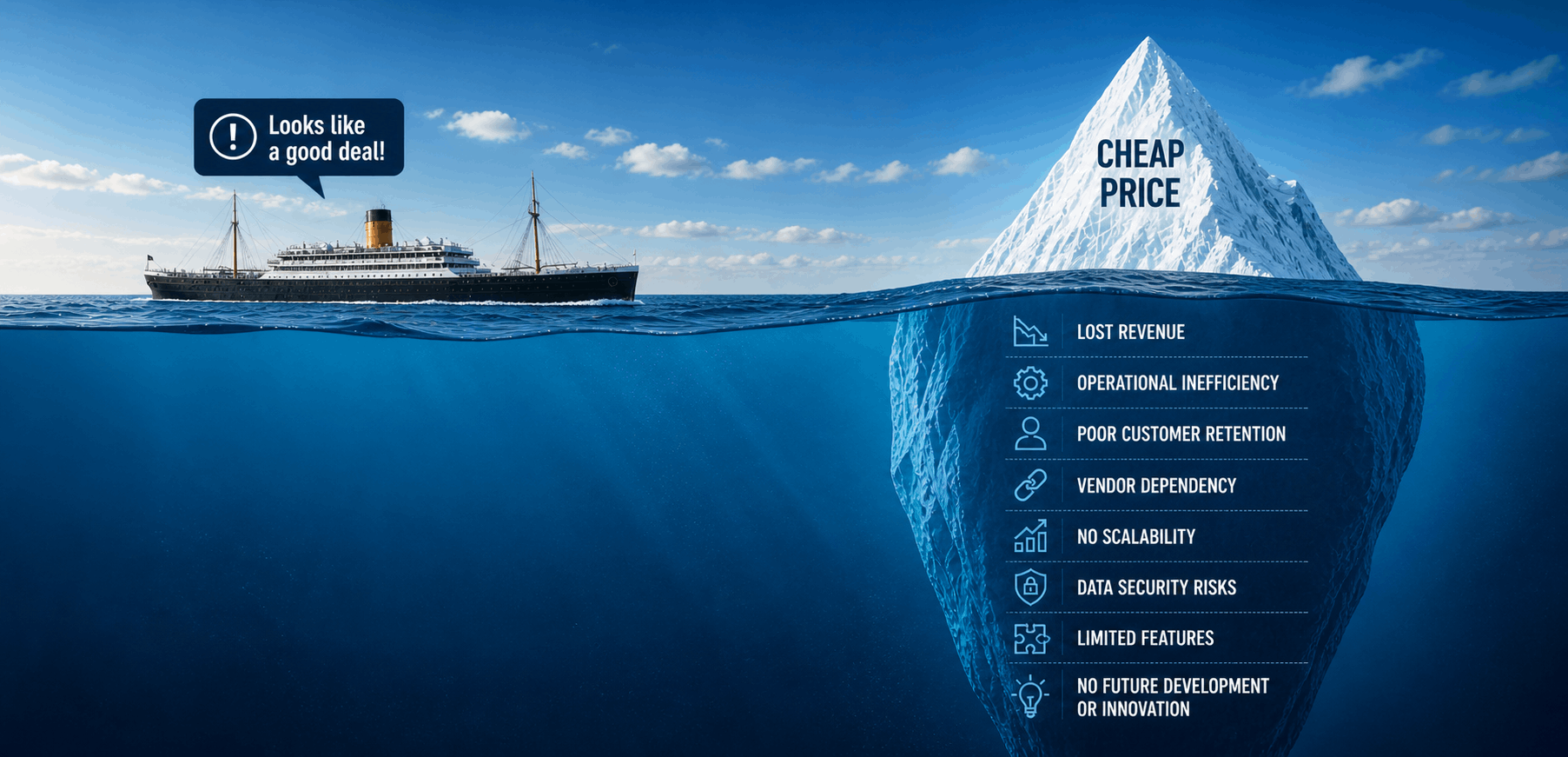
Choosing software for a business is not just a technical decision — it’s a long-term strategic one. This article explores the most common risks companies overlook, from hidden limitations and vendor dependency to data security and scalability, helping you avoid costly mistakes and choose a system that truly supports growth.
Most software decisions feel small at the moment they’re made.
You compare a few options, sit through a demo, look at pricing, maybe ask a few operational questions, and move forward. It feels like a practical step — something that will “help organize the business.”
But in reality, this is one of the most strategic decisions you will make.
Because once a system is implemented, it becomes part of how your business operates every day. It affects how your team works, how your customers interact with you, how decisions are made, and ultimately how your business grows.
And if the decision is wrong, the cost is not just financial. It shows up slowly — in lost time, lost customers, missed opportunities, and operational frustration.
Most of these risks are not obvious during the demo.
The Illusion of a “Good Price”
One of the first things owners look at is price.
It’s understandable. Especially in small and medium-sized businesses, cost control is part of daily thinking. When two systems seem similar, the cheaper option often feels like the safer choice.
But over time, that logic often proves wrong.
A lower-cost system may lack the tools that actually drive business performance. It may not support customer engagement, may not automate key processes, and may not provide useful insights. And what looks like savings at the beginning slowly turns into lost revenue.
Not because the system is broken, but because it is limited.
The real cost of software is not what you pay for it. It’s what it allows you to achieve — or prevents you from achieving.
When the System Becomes the Problem
Some systems try to do everything. Others do very little.
In both cases, the result can be the same: your team struggles to use it effectively.
If the system is too complex, staff avoid it. They find shortcuts, revert to manual processes, or make errors. Instead of improving efficiency, the system becomes a burden.
If the system is too simple, it cannot support your operations. You end up compensating with spreadsheets, messages, and additional tools. The system exists, but it doesn’t actually run the business.
In both scenarios, the promise of “better management” disappears.
The right system is not the one with the most features. It’s the one that fits your daily operations so naturally that your team uses it without thinking.
The Hidden Cost of Generic Software
Many businesses consider general-purpose tools — CRMs, booking systems, or generic management platforms.
They often look clean, flexible, and modern. But they are rarely built for the realities of fitness and wellness businesses.
Memberships, class schedules, attendance tracking, recurring payments, customer retention — these are not secondary features in your business. They are the core of it.
When the system does not understand these workflows, the business starts adapting to the software instead of the other way around.
That’s when workarounds begin.
A spreadsheet here, a manual list there, a workaround for bookings, another for payments. Over time, operations become fragmented, and data becomes unreliable.
It doesn’t fail immediately. It slowly becomes inefficient.
Growth That the System Cannot Support
Many systems work well in the beginning.
One location, manageable number of customers, simple operations — everything feels under control.
But businesses grow.
More locations. More staff. More customers. More complexity.
And suddenly, the system that once felt sufficient starts showing its limits.
It cannot handle multi-location logic properly. It struggles with performance. It lacks the flexibility to introduce new pricing models or services. Integrations become difficult. New technologies cannot be adopted.
At that point, changing the system becomes significantly harder and more expensive.
The real question is not whether the system works today.
It is whether it will still work when your business is twice the size.
And just as importantly, whether the vendor behind it is capable of evolving with the market.
You Are Choosing a Vendor, Not Just Software
Software is only part of the decision.
Behind every system is a company.
And that company will determine how your system evolves over time.
Some vendors build and maintain their products in-house. They understand their architecture, their customers, and their industry. They improve the system continuously.
Others rely heavily on third-party components or have limited technical control. Changes are slower. Innovation is limited. Support becomes reactive instead of proactive.
Some companies are deeply focused on a specific industry. Others are not.
This matters more than it seems.
Because when your business needs change — and they will — the system can only adapt as much as the vendor behind it can.
The Risk You Don’t See: Your Data
Your system holds some of your most valuable assets:
Customer data.
Behavior patterns.
Purchase history.
Operational performance.
In some cases, software is not developed as a true SaaS product. It may have started as an internal system used by a business, later offered to others. Or it may rely on external services that introduce additional layers of access.
This creates questions that many businesses don’t ask:
Who owns the data?
Who can access it?
How is it protected?
Is the vendor independent from your competitors?
If these questions are not clearly answered, you are taking a risk — even if nothing goes wrong.
And in business, risks that are invisible are often the most dangerous.
The Vendor Behind the System
When you choose software, you are entering a long-term relationship.
Your operations will depend on it. Your team will rely on it. Your data will live inside it.
But what happens if the company behind it slows down, changes direction, or disappears?
This is not theoretical. It happens.
That is why it’s important to look beyond the product itself.
What has the company built so far?
How consistent is their growth?
Do they actively improve the product?
Do they have real customers using it successfully?
Will they still be here in a few years?
You are not just buying a tool.
You are choosing stability.
Final Thought
Choosing software is often treated as a technical decision.
In reality, it is a strategic one.
The right system quietly supports growth. It improves efficiency, strengthens customer relationships, and enables better decisions.
The wrong system does the opposite — slowly, quietly, and consistently.
Most businesses focus on features.
The stronger ones focus on risks.
Because in the long run, avoiding the wrong decision is often more valuable than making the perfect one.
Author

Shota Kvaratskhelia
Digital creator, entrepreneur, engineer